Profiles
Company profiles side by side: search presence, whether AI assistants can read the site, content engine, structured data and technology.
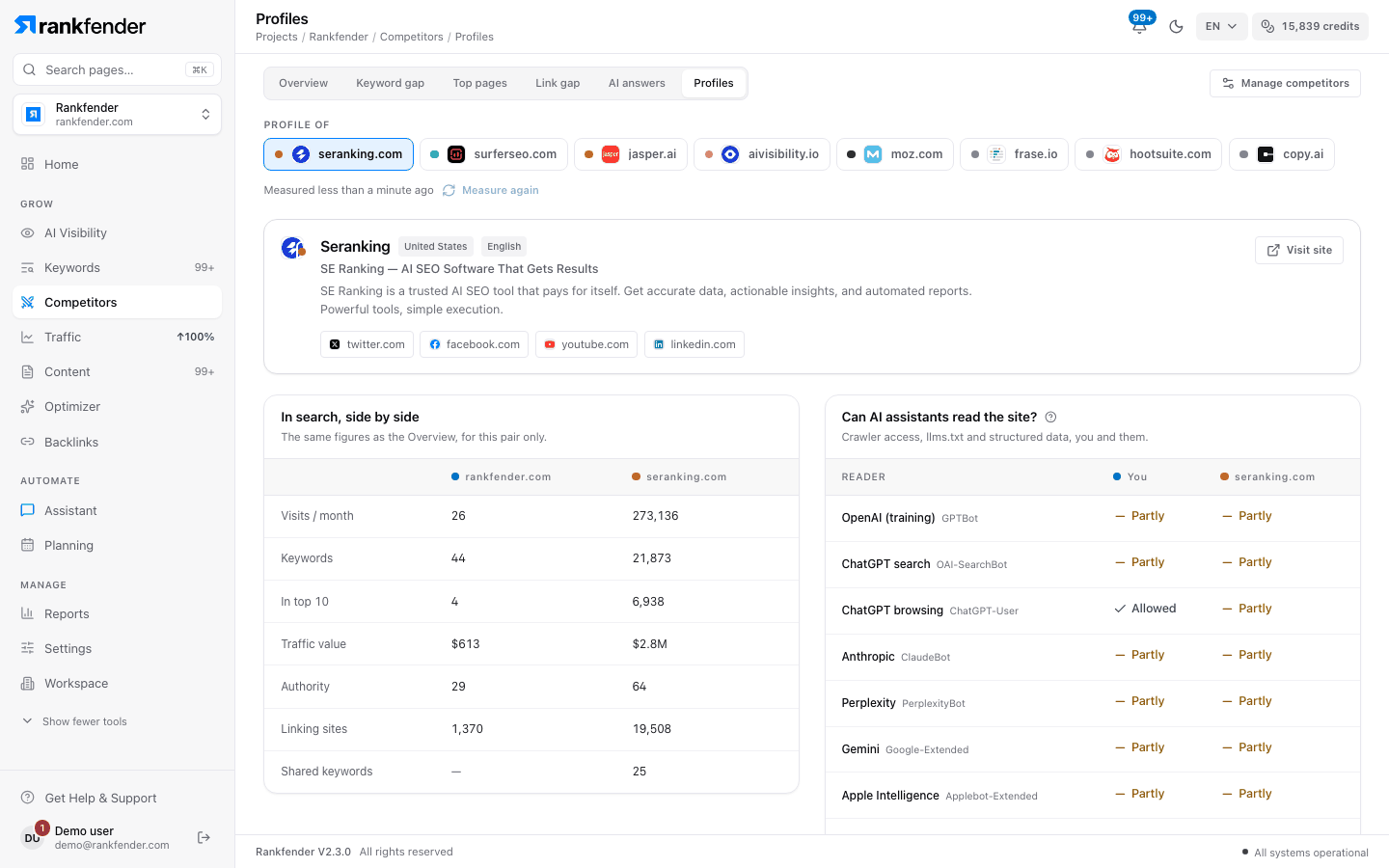
Profiles puts one competitor next to you, signal by signal: how they do in search, whether AI assistants may read their site, how big and fresh their content is, what structured data they publish and what their site is built with.
Pick a profile
Choose the competitor in "Profile of", or click a competitor in Overview › "Side by side". The first time, Rankfender opens their home page, reads their robots.txt, llms.txt and sitemap, detects the technology the site runs on and compares it with yours. "Measure again" re-measures both profiles, theirs and yours.
The header
Logo and name, country and language badges, their home page title and description, the social profiles linked from the site, and "Visit site". "Site didn't answer" means their home page did not respond. When Rankfender wrote a short analysis of this competitor while setting up your project, you also see "Market position", "Pricing", "Strengths" and "Weaknesses".
In search, side by side
The same figures as the Overview, for this pair only: "Visits / month", "Keywords", "In top 10", "Traffic value", "Authority", "Linking sites" and "Shared keywords". They are estimates from a search-data provider; see Overview.
Can AI assistants read the site?
AI assistants only name sites their crawlers may read. Each site says which crawlers it allows in its robots.txt. This card lists 10 AI crawlers ("Reader"), such as GPTBot, OAI-SearchBot, ClaudeBot and Google-Extended, with the rule each site applies to its home page.
| Value | What it means |
|---|---|
| "Allowed" | The crawler may read the home page. |
| "Blocked" | robots.txt forbids it. |
| "Partly" | Some paths are allowed, others are blocked. |
| "Unknown" | The robots.txt didn't answer, so access can't be read. |
Below the crawlers: "llms.txt" ("Present" or "Absent"), a short guide written for AI, and "Structured data types" on the home page. A site without robots.txt lets every crawler in. When one side blocks crawlers, a note says so, for example "You block N AI crawlers — those assistants can't read your site." To check your own site in depth, see Every check explained.
Content engine
Size and freshness from their sitemap: "Pages", "Fresh, 30 days", "Fresh, 90 days" and "Languages" (the language versions their home page declares), each with "yours: N" for your site.
Structured data on their home page
The schema types they publish on their home page, which tell search engines and AI what they are. Each type is marked "You use it too" or "Only they use it"; the highlighted ones are types they use and your home page doesn't.
Built with
The technology detected on their site, grouped by kind (for example content system, analytics, hosting). "Nothing detected." when none is found.
Note
Crawler access, llms.txt and structured data are read from each site's own public files on the day shown in "Measured …". Structured data is checked on the home page only, so a site may use more types on other pages. Technology detection can miss tools that leave no trace in the page.