Overview
The competitive map, where their keywords rank, visits over 12 months, the side-by-side table and momentum.
Overview answers one question: where do you stand against the competitors you track? It puts you and up to 8 competitors side by side in Google search, links and AI answers, then sums it up in one sentence such as "You rank #3 of 6 in organic search visits."
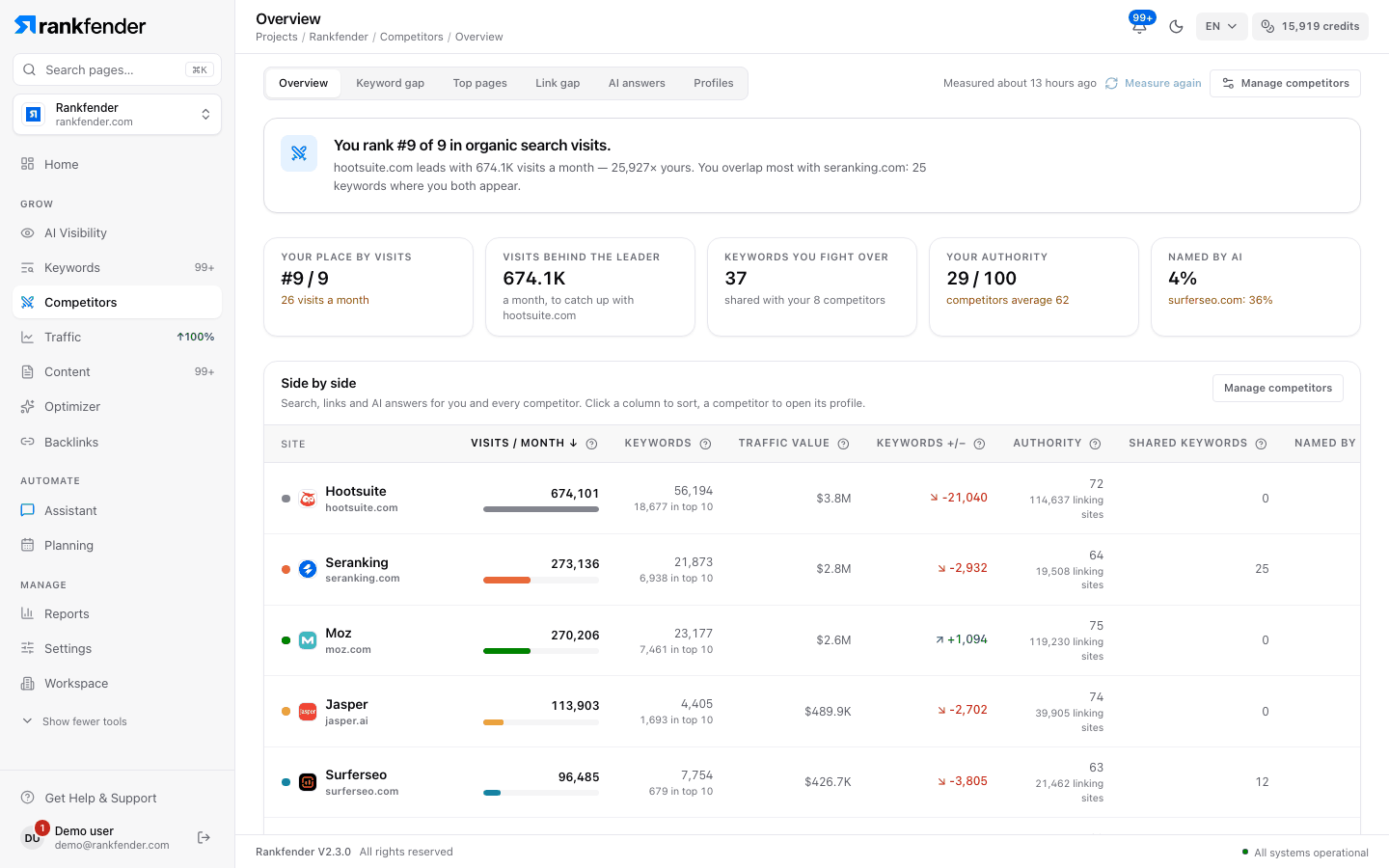
The verdict and the five figures
Under the verdict, which also names the leader and the site you overlap with most, five figures prove it.
| Figure | What it shows |
|---|---|
| "Your place by visits" | Your rank among all sites by estimated monthly visits, with your visits a month. |
| "Visits behind the leader" | The monthly visits between you and the leader. Hidden when you lead. |
| "Keywords you fight over" | Shared keywords, added up over all your competitors. |
| "Your authority" | Your link strength from 0 to 100, with your competitors' average. |
| "Named by AI" | The share of your AI answers that name you, with the most-named competitor. Needs AI answers from AI Visibility. |
Competitive map
Each bubble is a site. Further right means more keywords ("Keywords ranked"), higher means more visits, bigger means more authority. Both axes grow in ×10 steps so small and large sites fit on one map. A site high and to the left gets many visits from few keywords: it holds the top spots on the searches that matter.
Where their keywords rank
One bar per site splits its keywords into position bands: #1, #2–3, #4–10, #11–20 and #21–100. The darker the band, the more visits it brings. The figure on the right is the "Share of keywords in the top 10". Visits come almost only from the first page, so two sites with the same number of keywords can get very different traffic.
Visits over 12 months
A line chart of estimated monthly visits, month by month, for you and your 3 closest competitors (the ones you share the most keywords with). The curves are kept between measurements; each "Measure again" adds the latest months.
Side by side
One row for you and one per competitor. Click a column to sort, or a competitor to open its profile ("Open profile").
| Column | What the number is |
|---|---|
| "Visits / month" | Visits a month from organic search results, worked out from every keyword the site ranks for and how many people click at that position. |
| "Keywords" | Searches the site appears for in the top 100, with "N in top 10" below. For you, Search Console's count is used when it is higher. |
| "Traffic value" | What those visits would cost a month if bought as search ads. A quick way to compare how commercial each site's traffic is. |
| "Keywords +/−" | Keywords gained minus keywords lost since the previous measurement. Hover to see both numbers. |
| "Authority" | Link strength from 0 to 100, from how many sites link to it and how strong they are, with "N linking sites" below. |
| "Shared keywords" | Keywords where you and this site both show up. The higher, the more directly you compete. |
| "Named by AI" | Share of AI answers that name the site, over your project's questions. Questions that contain your brand are left out. |
| "12 months" | A small visits curve, for you and your 3 closest competitors. |
Found for you
Below the table, "Also competing with you in search" lists up to 12 sites that rank for many of your searches and that you don't track yet, each with "N shared keywords · N visits a month". Click "Track" to add one; the Overview measures again with it. Directories, marketplaces and social networks are left out.
These are estimates
Visits, keywords, positions and traffic value come from a search-data provider. Visits are worked out from the positions a site holds and how many people usually click at each position. They are not the competitor's own analytics and can differ a lot from what the site really gets. Use them to compare sites with each other, not as exact counts.
To change who is compared, or to measure again, see Competitor Intelligence.